Australia leads the women’s cricket world cup winners list with seven titles, and they’re not slowing down anytime soon. England sits close behind with four trophies. New Zealand and India have one championship each, and India’s 2025 win changed the entire conversation around the sport. This guide walks you through every champion, every final, and every twist since the tournament began in 1973.
Most Women’s Cricket World Cup Winners All Time
Here’s the short version. The Women’s Cricket World Cup started back in 1973, actually two years before the men’s version existed. Since then, thirteen editions have crowned a champion. Only four countries have ever lifted the trophy, which tells you how tightly this competition is guarded at the top.
| Team | Titles Won | Years |
| Australia | 7 | 1978, 1982, 1988, 1997, 2005, 2013, 2022 |
| England | 4 | 1973, 1993, 2009, 2017 |
| New Zealand | 1 | 2000 |
| India | 1 | 2025 |
Now let’s unpack how each of these wins happened.
How the Women’s Cricket World Cup Began
England hosted the very first tournament in 1973, and fittingly, they also won it. Back then, the format worked as a round-robin league, so there wasn’t even a final match. Whoever finished top of the table took the trophy home.
That first edition featured just seven teams, a modest number compared to today’s global reach. Still, it planted a seed. Women’s cricket needed a stage, and this tournament gave it one, years before the men’s game caught up with its own 50-over world event.
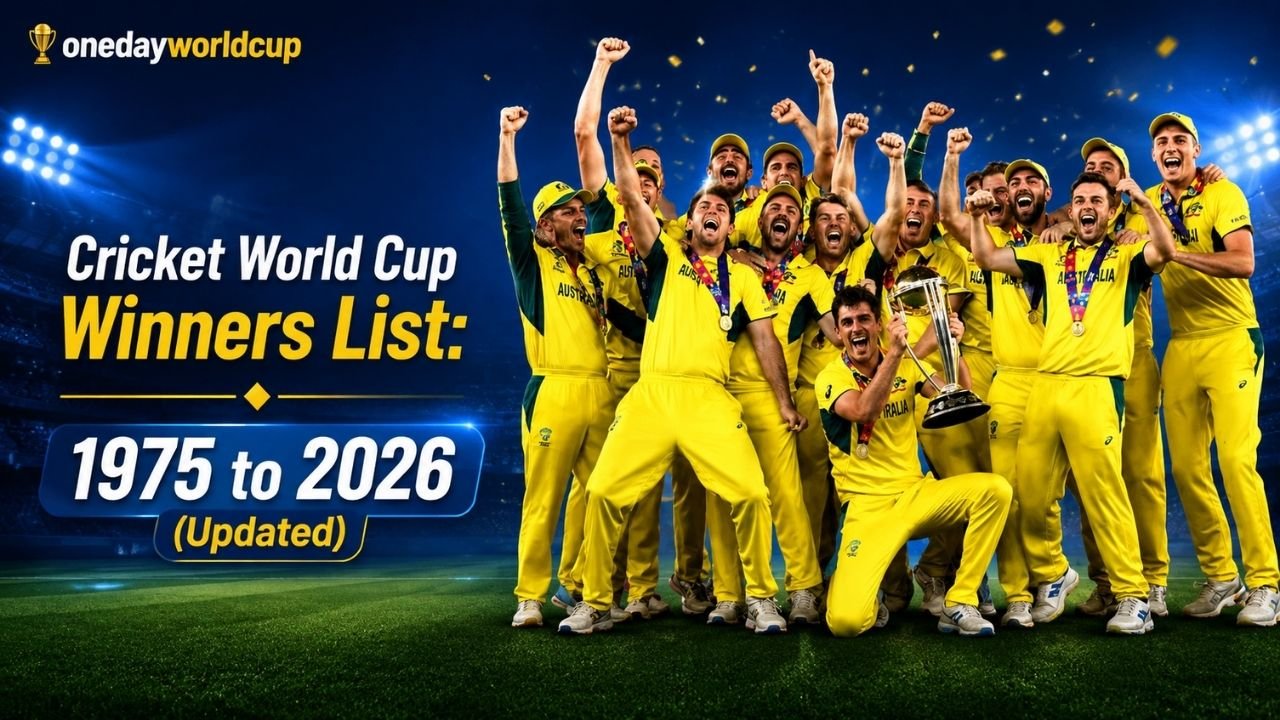
- Check This Also: Cricket World Cup Winners List: 1975 to 2026 (Updated)
The Complete Women’s Cricket World Cup Winners List By Year
If you’re scanning for the fastest answer, here’s the full women’s cricket World Cup winners list, year by year, host country included.
| Year | Host Country | Winner | Runner-Up |
| 1973 | England | England | Australia (top of table) |
| 1977/78 | India | Australia | England |
| 1981/82 | New Zealand | Australia | England |
| 1988/89 | Australia | Australia | England |
| 1993 | England | England | New Zealand |
| 1997/98 | India | Australia | New Zealand |
| 2000/01 | New Zealand | New Zealand | Australia |
| 2004/05 | South Africa | Australia | India |
| 2008/09 | Australia | England | New Zealand |
| 2012/13 | India | Australia | West Indies |
| 2017 | England | England | India |
| 2021/22 | New Zealand | Australia | England |
| 2025 | India | India | South Africa |
Notice something interesting here. A final wasn’t even part of the format until 1981/82. Before that, the top team simply won by league standings, no knockout drama involved.
Australia’s Long Grip on the Trophy
Australia didn’t just win the women’s cricket World Cup more than anyone else; they built a dynasty around it. Seven titles across five decades is not luck. It’s a system.
Their wins stretch from 1978 all the way to 2022, which means Australia has stayed dominant across generations of players. Between 2013 and 2022, they didn’t lose a single World Cup final. That kind of consistency rarely happens in team sports, let alone one as unpredictable as cricket.
A few reasons explain this streak:
- Strong domestic structures through the Women’s Big Bash League
- Early professionalization of women’s contracts
- Consistent talent pipelines from age-group cricket
- A batting and bowling depth that survives injuries and retirements
Because of this, Australia remains the benchmark every other team measures itself against.
England’s Golden Moments
England holds four titles, and each one arrived at a meaningful time for the sport. Their first came in 1973 as tournament hosts. Their next, in 1993, also came on home soil. Then 2009 and 2017 followed, both cementing England as the second-most successful team in tournament history.
The 2017 final deserves a special mention. Played at Lord’s in front of a sold-out crowd, England beat India in a tense, low-scoring thriller. That match is often credited with pushing women’s cricket into mainstream British sports coverage for good.
New Zealand’s One Shining Run
New Zealand has only won once, but 2000 remains a landmark moment for the team. Hosting the tournament on home soil, they beat Australia in the final, snapping the Australians’ momentum at exactly the right time.
Since then, New Zealand has reached finals but hasn’t crossed the line again. Their 2000 win still stands as proof that any team, given the right conditions and belief, can break the Australia-England stranglehold.
India’s Long-Awaited Breakthrough in 2025
For decades, India chased this trophy without quite reaching it. They finished runners-up in 2005 and again in 2017. Both losses stung, but they also built something valuable: experience, resilience, and a fan base hungry for a title.
That wait ended on November 2, 2025. Playing as tournament hosts at DY Patil Stadium in Navi Mumbai, India defeated South Africa by 52 runs to win their first-ever Women’s Cricket World Cup. Opener Shafali Verma scored a career-best 87, helping India post 298 for 7. South Africa fought hard through captain Laura Wolvaardt’s century but eventually fell to 246 all out, with spinner Deepti Sharma taking five wickets to seal the win.
This victory did more than add India’s name to the women’s cricket world cup winners list. It sparked street celebrations across the country and pushed women’s cricket into a completely new spotlight in India.
Why India’s 2025 Win Matters So Much
- It was India’s third World Cup final appearance, after 2005 and 2017
- South Africa reached their first-ever final, making it a historic match for both sides
- The win came on home soil, adding emotional weight for players and fans alike
- It broke a semifinal streak where India beat seven-time champions Australia along the way
Runners-Up Who Almost Made History
Winning gets the headlines, but plenty of teams came agonizingly close. Here’s a look at teams that reached finals without lifting the trophy.
| Team | Final Appearances Without a Win | Notable Years |
| India | 3 | 2005, 2017 |
| New Zealand | Multiple | 1997/98, 2021/22 |
| West Indies | 1 | 2012/13 |
| South Africa | 1 | 2025 |
South Africa’s 2025 run stands out especially. Reaching a maiden final against a red-hot Indian side was no small feat, and it signals a genuine rise for South African women’s cricket going forward.
How the Tournament Format Changed Over Time
The competition hasn’t looked the same in every era, and understanding this helps explain some of the results in the women’s cricket world cup winners list.
- 1973 to 1978 — Round-robin format, no final match at all
- 1981/82 — A proper final introduced for the first time
- 1997/98 — Semi-finals added, along with quarter-finals in that single edition only
- 1988/89 and 2012/13 — Third-place and fifth-place playoffs used in place of semi-finals in certain years
- 2017 onward — Standard knockout structure with semi-finals leading into one final
This evolution matters because early champions won under very different pressure conditions than recent ones. A round-robin title and a knockout final trophy carry different weight, even though both count equally in the record books.
Records Worth Knowing
A few numbers stand out when you study the tournament closely.
- Australia has appeared in the most finals of any team, by a wide margin
- England and Australia have met in more World Cup finals than any other pairing
- India’s 2025 win came in their home tournament, joining a short list of hosts who also won the title
- Only four nations have ever won the trophy across thirteen editions, out of dozens that have competed
That last point really puts the difficulty into perspective. Qualifying is hard enough. Winning is a different level entirely.
What’s Next: The 2029 Women’s Cricket World Cup
Attention has already started shifting toward the next edition. While hosting details and format specifics will firm up closer to the tournament, one thing seems certain: with India now a champion, Australia still hungry to reclaim dominance, and England always in contention, the next cycle should be fiercely competitive.
Teams like South Africa, after their 2025 final run, and a resurgent New Zealand side will also enter as genuine contenders, not just participants making up the numbers.
Conclusion
The women’s cricket World Cup winners list tells a story bigger than just trophies and scorecards. It’s a story of Australia’s relentless consistency, England’s steady class, New Zealand’s one perfect run, and India’s long, emotional road to a first title in 2025. Each name on that list represents years of struggle, growth, and belief from players who built the sport from the ground up. As new teams rise and old rivalries continue, this list is far from finished, and the next chapter promises to be just as compelling as the last.
FAQs
Australia leads with seven titles, won in 1978, 1982, 1988, 1997, 2005, 2013, and 2022. No other team comes close to matching that total.
Only four teams have ever won it: Australia, England, New Zealand, and India. Despite many participants over the decades, the trophy has stayed within this small group.
India won their first-ever title in 2025, beating South Africa by 52 runs in the final held at DY Patil Stadium, Navi Mumbai, on November 2, 2025.
The first tournament took place in 1973 in England, making it older than the men’s Cricket World Cup, which began in 1975.
No. The 1973 and 1977/78 editions used a round-robin league format without a final. A proper final was introduced starting in 1981/82.
England has won four times, in 1973, 1993, 2009, and 2017, making them the second most successful team in tournament history.
No, South Africa has not won yet. However, they reached their first-ever final in 2025, losing to India, which marked a major milestone for their program.
New Zealand won on home soil, defeating Australia in the final. It remains their only title, achieved during a period when Australia was otherwise near-dominant.