Cricket has given fans plenty of long-running contests, but few carry the weight and depth of the India national cricket team vs West Indies cricket team timeline. What started as a modest five-match Test series in 1948 has, over the decades, turned into a full three-format rivalry played out across Tests, ODIs and T20Is. Along the way, IND vs WI cricket has produced some of the biggest names the sport has known, from Frank Worrell and Garry Sobers in the early years to Sachin Tendulkar, Brian Lara and, more recently, Virat Kohli.
This piece walks through the complete story of india vs west indies cricket – how the rivalry began, how the balance of power moved from one side to the other, and where things stand as both teams prepare for their 2026 white-ball series.
Today’s Match: 3rd ODI, New Chandigarh (3 October 2026)
- Status at the time of writing: upcoming. Live sources showed the match had not yet started. Toss: 1:30 PM IST. First ball: 2:00 PM IST. Check a live scorecard for the toss and running score.
- Venue: Maharaja Yadavindra Singh International Cricket Stadium, Mullanpur, New Chandigarh. First men’s ODI at this ground.
- Series situation: India lead 2-0 and have already sealed the series. West Indies are playing to avoid a whitewash.
- Team news: Prasidh Krishna is out with a hamstring injury; Anshul Kamboj added to the squad. Mohammed Siraj is expected to return. West Indies have taken only 4 wickets while conceding 706 runs in the first two games.
- Probable XIs (not confirmed until the toss):
- India: Rohit Sharma, Shubman Gill (c), Virat Kohli, Ruturaj Gaikwad, KL Rahul (wk), Naman Dhir, Ravindra Jadeja, Kuldeep Yadav, Mohammed Siraj, plus two from Gurnoor Brar, Auqib Nabi and Anshul Kamboj.
- West Indies: John Campbell, Keacy Carty, Shai Hope (c, wk), Amir Jangoo, Sherfane Rutherford, Roston Chase, Keemo Paul, Alzarri Joseph, Shamar Joseph, Jayden Seales, Vitel Lawes.
The 2026 Series: Schedule, Results and Squads
West Indies are touring India from 27 September to 17 October 2026 for three ODIs and five T20Is across eight cities.
| Match | Date | Venue | Result / status |
|---|---|---|---|
| 1st ODI | 27 Sep | Thiruvananthapuram | India won by 8 wickets. WI 295/7, India 300/2 (41.4 ov) |
| 2nd ODI | 30 Sep | Guwahati | India won by 8 wickets. WI 405/7, India 406/2 (43.3 ov) |
| 3rd ODI | 3 Oct | New Chandigarh | Today, 2:00 PM IST. India lead 2-0 |
The First Chapter: 1948 and the Opening Series
The india national cricket team vs west indies cricket team timeline truly begins with West Indies’ tour of India in 1948–49. Indian cricket was still finding its footing internationally at the time, while this west indies vs india series opener made it clear just how far ahead the Caribbean side already was in terms of experience and match temperament.
The first Test, played at Delhi’s Feroz Shah Kotla – now known as Arun Jaitley Stadium – from November 10 to 14, 1948, ended in a draw. Two more stalemates followed in Bombay and Calcutta before West Indies picked up their first win of the series at Madras. Taking that match by an innings and 193 runs. The final Test in Bombay was drawn again, leaving West Indies with a 1–0 series win and four draws in between.
| Test | Venue | Result |
| 1st Test | Delhi | Draw |
| 2nd Test | Bombay | Draw |
| 3rd Test | Calcutta | Draw |
| 4th Test | Madras | West Indies won by an innings & 193 runs |
| 5th Test | Bombay | Draw |
Even though nothing separated the sides across most of the series, this wi vs ind meeting set the template for what was to come – a well-drilled Caribbean unit testing a young Indian team that was still learning how to close out matches at the international level.
India Travels to the Caribbean for the First Time
The next chapter in the india vs west indies story arrived in 1952–53, when India made its first tour of the West Indies. The trip exposed Indian batsmen to genuine pace and bounce, conditions quite unlike anything they had grown up playing on at home.
The tour opened with a draw in Port of Spain, but West Indies took the second Test in Bridgetown by 142 runs and closed out the series 1–0. For Indian cricket, the real value of this tour wasn’t measured only in the scoreline – it was about learning to survive in unfamiliar conditions against an opponent that was improving with every passing year.
The Caribbean Side Takes Control: 1950s and 1960s
Through much of the 1950s and 1960s, this west indies vs india contest tilted heavily in the Caribbean team’s favour. The 1958–59 series played in India is a good example – West Indies won three of the five Tests, including a crushing innings-and-336-run victory in Kolkata.
These were also the years when Garry Sobers rose to become one of the finest all-rounders the sport has ever produced. While West Indies built a reputation for batting depth and bowling variety that very few teams could match at the time. India, meanwhile, was still assembling the pieces – technically sound batsmen, a bowling attack that was slowly maturing, and the self-belief needed to eventually challenge the strongest side in world cricket.
1971: The Series That Changed Everything
Nothing reshaped the india national cricket team vs west indies cricket team timeline quite like the tour of 1971. Led by Ajit Wadekar, India travelled to the Caribbean and won the five-Test series 1–0 – its first-ever series victory on West Indian soil.
A young Sunil Gavaskar was the difference-maker on that tour, piling on runs against an experienced attack. Instantly announcing himself as one of the finest opening batsmen in the game. This wi vs ind triumph did more than hand India a scoreline; it gave Indian cricket the confidence that it could beat the very best sides away from home.
For West Indies, the defeat served as an early warning that their grip on ind vs wi cricket would not go unchallenged forever. Many historians still point to 1971 as the moment Indian Test cricket began to grow into a genuinely competitive force.
The Age of Fearsome Fast Bowling
What followed 1971 was arguably West Indies’ most intimidating stretch of cricket. Bowlers such as Andy Roberts, Michael Holding, Joel Garner, Colin Croft, Malcolm Marshall. Later Curtly Ambrose and Courtney Walsh built attacks that unsettled batting line-ups across the world.
For India, every india vs west indies contest during this period meant facing bowling of a completely different class. Yet the era also produced some of India’s finest batting performances, with Gavaskar again central to the story, earning a reputation for handling extreme pace with remarkable calm.
The rivalry also picked up a brand-new format in 1979, when the first official ODI between the two sides was played at Edgbaston during that year’s World Cup. West Indies won comfortably by nine wickets, adding one-day cricket to what had, until then, been a purely Test-match affair.
1983: The World Cup Final That Changed Indian Cricket
Any serious account of ind vs wi history has to pause at Lord’s in 1983. West Indies arrived as defending champions and heavy favourites. India, batting first, were bowled out for a modest 183 – a total that looked well short of what a batting line-up as strong as West Indies possessed.
What followed has become part of cricketing folklore. Kapil Dev’s bowlers stayed disciplined, chipped away at crucial moments, and eventually dismissed West Indies for 140, sealing a stunning 43-run win.
Why That Day Still Matters
- It gave India its first-ever World Cup title
- It changed how cricket was followed and funded across India
- It proved that even a heavily favoured west indies vs india side could be beaten on the biggest stage
- Kapil Dev lifting the trophy remains one of the most replayed images in Indian sport
Test cricket, however, told a very different story that same year. In the 1983 series played in India, West Indies won the decider at Eden Gardens, with Clive Lloyd scoring 161 and Malcolm Marshall and Michael Holding doing the rest with the ball. It was proof that a single result rarely captures the full picture of this wi vs ind contest.
The Tendulkar and Lara Years
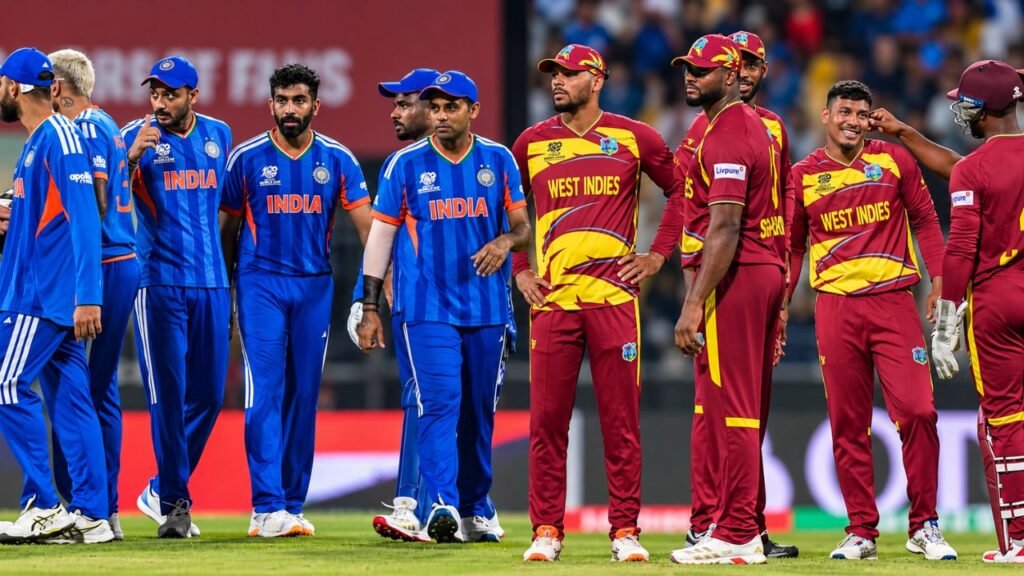
The 1990s handed the rivalry two batsmen who would go on to define an entire generation of cricket – Sachin Tendulkar for India and Brian Lara for West Indies. Every time india vs west indies cricket was played during this decade, comparisons between the two were never far behind.
Tendulkar’s game was built on consistency and technique that travelled well across conditions. Lara’s was built on flair – an ability to produce match-turning innings seemingly out of nowhere. Together, the pair turned an already storied rivalry into essential viewing for a whole new generation of fans.
The 1997 Barbados Collapse
One Test from this period is still talked about – Bridgetown, 1997. Chasing only 120, India had Tendulkar, Rahul Dravid, Sourav Ganguly and VVS Laxman in the side and looked comfortably placed to win. Instead, Ian Bishop, Curtly Ambrose and Franklyn Rose ran through the batting order. Laxman was the only batsman to reach double figures as India collapsed, handing West Indies a memorable win in this west indies vs india series.
2002: The Last Series West Indies Won
West Indies’ most recent series win in ind vs wi Test cricket came in 2002, when they beat India 2–1. Shivnarine Chanderpaul was central to that victory, especially in the decisive Kingston Test, where his batting proved almost impossible for India’s bowlers to break down.
That 2002 result carries extra weight in hindsight – it marks the last time West Indies has managed to win a full Test series against India, a gap that has only widened with each passing year.
India’s Test Cricket Takes Off
The 2000s saw a completely different Indian side emerge. Under Sourav Ganguly, and later Rahul Dravid, India built a team with real depth – Dravid, Laxman, Virender Sehwag, Anil Kumble and, before long, MS Dhoni all played their part in that transformation.
The clearest marker of this shift arrived in 2006, when India, led by Dravid, won a Test series in the Caribbean for the first time since 1971. The fourth Test at Sabina Park stood out in particular, with Anil Kumble’s six-wicket haul in the second innings helping India defend a target and end a 35-year wait for series success on West Indian soil. This india vs west indies win remains one of the more significant results of the modern era.
T20 Cricket Joins the Conversation
The india national cricket team vs west indies cricket team timeline took on a fresh dimension in 2009, when the two sides played their first T20I at Lord’s on June 12. West Indies won by seven wickets, and a brand-new chapter of wi vs ind cricket had officially begun.
T20 cricket asked for a completely different skill set – clean hitting, sharp bowling changes and split-second decision-making. West Indies adapted quickly, going on to lift the T20 World Cup in both 2012 and 2016. India built its own strength in the format largely through the growth of the IPL, which gave the country a much deeper pool of white-ball talent to choose from.
2016: Two Results, Two Different Stories
Few years capture the contrasts of india vs west indies cricket better than 2016.
The Mumbai Semifinal Shock
In the T20 World Cup semifinal at Mumbai, West Indies produced a stunning chase in front of a packed home crowd, with Lendl Simmons, Johnson Charles and Andre Russell all playing key roles. It was a reminder that in the shortest format, this ind vs wi battle could swing on a handful of overs, regardless of the occasion or the crowd.
Kohli’s 200 in Antigua
Later that year, India toured the Caribbean under Virat Kohli. In the very first Test at Antigua, Kohli scored 200, becoming the first Indian captain to make a double century overseas, and India went on to win by an innings and 92 runs. Ravichandran Ashwin also had a strong series with both bat and ball as India closed out the four-Test series 2–0.
Taken together, these two results sum up exactly where west indies vs india cricket stood by the mid-2010s – unpredictable whenever white-ball cricket was involved, but increasingly one-sided the moment the format switched to Tests.
2019 World Cup: Another Statement Win
At the 2019 World Cup, India – unbeaten heading into the fixture – met West Indies at Old Trafford. Mohammed Shami, Jasprit Bumrah and the rest of the bowling group kept things tight throughout the innings, and India cruised to a 125-run win, extending its strong recent record in ind vs wi World Cup fixtures.
Head-to-Head: The Numbers So Far
The scoreline of wi vs ind cricket looks quite different depending on which years you focus on, since much of West Indies’ historical advantage dates back several decades to a very different era of the sport.
| Format | Total Matches | West Indies Wins | India Wins | Draws / No Result |
| Tests | 102 | 30 | 25 | 47 |
| ODIs | Rivalry began in 1979 | Strong early record | Increasingly dominant since 2000s | – |
| T20Is | Rivalry began in 2009 | Competitive, power-hitting driven | Growing depth through IPL era | – |
The takeaway is fairly simple: West Indies still lead the all-time Test count, but India has won every single bilateral series in india vs west indies Test cricket since 2002 – a clear sign of just how far the balance has shifted in recent years.
Memorable Moments Worth Remembering
Beyond the headline series, a handful of individual matches have stayed with fans long after the scorecards were filed away.
- 1971, Port of Spain and beyond – Gavaskar’s breakout tour that gave India belief in the Caribbean
- 1983, Eden Gardens – a reminder that West Indies remained a Test powerhouse even after losing the World Cup final
- 1997, Bridgetown – a batting collapse that showed how quickly momentum could flip
- 2006, Sabina Park – Kumble’s six-wicket spell that ended a 35-year drought
- 2016, Wankhede – a semifinal chase that silenced a full house
- 2016, Antigua – Kohli’s double century that confirmed India’s new Test identity
Each of these moments belongs to a different era of the rivalry, yet together they explain why the contest still carries so much weight whenever the two sides meet.
The Players Who Built This Rivalry
Few rivalries in world cricket can boast a list of names quite like this one.
West Indies legends
- Sir Garfield Sobers – cricket’s greatest all-rounder
- Viv Richards – one of the most feared batsmen of any era
- Clive Lloyd – captain of a dominant generation
- Malcolm Marshall, Michael Holding, Andy Roberts, Joel Garner – pace-bowling greats
- Brian Lara – a record-breaking left-hander
- Chris Gayle – T20 cricket’s ultimate power hitter
India legends
- Sunil Gavaskar – mastered West Indies’ pace attack better than most
- Kapil Dev – the face of the 1983 World Cup triumph
- Sachin Tendulkar – two decades of batting excellence
- Anil Kumble and Rahul Dravid – architects of the 2006 Caribbean win
- Virat Kohli – modern Test dominance, capped by that 2016 double century
These are the players who turned west indies vs india contests into can’t-miss cricket, generation after generation.
Why Conditions Have Always Played a Role
Conditions have shaped ind vs wi cricket from the very start. Indian pitches traditionally favoured spin and slower surfaces, while Caribbean grounds were built for pace and bounce. That distinction has faded somewhat in recent years – Indian tracks now often assist fast bowlers, while some Caribbean surfaces have slowed down considerably.
This is exactly why comparing a Test from the 1950s to one played in the 2020s needs a bit of care. Equipment, fitness levels, coaching methods and pitch preparation have all changed enormously, and those shifts matter just as much as the scorecards themselves when judging how strong a team really was.
How the Format Mix Has Evolved
Cricket itself has changed shape several times over the course of this rivalry, and each shift left its mark on how the two teams approached each other.
- In the 1950s, everything revolved around five-day Test matches
- By the late 1970s, one-day cricket had entered the picture
- The 1983 World Cup final reshaped how limited-overs cricket was viewed in India
- The 1990s were defined by two batting icons rather than by team results alone
- The 2000s belonged to India’s rise as a serious Test-match force
- 2009 onward, T20 cricket added an entirely new layer of unpredictability
Every one of these phases still shapes how fans and analysts talk about the contest today.
Looking Ahead: The 2026 Series
The india national cricket team vs west indies cricket team timeline adds its next entry on September 27, 2026, when India hosts West Indies for three ODIs followed by five T20Is.
| Squad | Captain | Notable Players |
| ODI Squad | Shubman Gill | Rohit Sharma, Virat Kohli, KL Rahul, Ravindra Jadeja |
| T20I Squad | Shreyas Iyer | Abhishek Sharma, Ishan Kishan, Sanju Samson, Tilak Varma, Arshdeep Singh |
The squads blend seasoned campaigners with younger players who have come through domestic and franchise cricket, a pattern that is likely to define wi vs ind cricket for the next few years as both boards plan ahead for future World Cup cycles.
Why This Rivalry Still Draws Crowds
Few international contests connect as many generations of players as india vs west indies cricket does. Follow the thread and you move from Worrell and Sobers, to Gavaskar and Kapil Dev, to Tendulkar and Lara, to Dravid, Kumble, Dhoni and Gayle, and finally to Kohli, Rohit Sharma and the players coming through today.
The two boards also represent very different cricketing pathways. India’s strength is built on deep domestic structures and batting depth, while West Indies’ strength comes from raw athleticism and a fast-bowling legacy that has rarely been matched anywhere else. That contrast is exactly what keeps west indies vs india fixtures worth watching, no matter which format is being played.
The Role of Domestic Cricket and the IPL
Part of why India’s side of this rivalry looks so different today comes down to structure. A packed domestic season, feeding directly into the IPL, has given Indian cricket a talent pipeline that simply didn’t exist a few decades ago. Young batsmen and bowlers now arrive in the national set-up having already played under serious pressure, in front of big crowds, against high-quality overseas players.
West Indies, working with a smaller player base spread across several nations, has taken a different route – leaning on natural athleticism, franchise T20 experience picked up around the world, and a handful of genuinely destructive match-winners. Neither approach is right or wrong; they’re simply two different ways of building a competitive side, and that difference shows up clearly whenever the two teams meet.
Closing Thoughts
The india national cricket team vs west indies cricket team timeline runs from a rain-hit draw in Delhi in 1948 to a fully professional, three-format rivalry heading into 2026. West Indies ruled the early decades and fielded one of the greatest sides the sport has ever seen through the 1970s and 1980s. India’s win in 1971 and its World Cup triumph in 1983 changed that relationship for good, and the years since 2002 have seen India grow into the stronger Test side, even as West Indies keeps producing explosive white-ball talent of its own.
As both sides get ready for their 2026 series, the story of ind vs wi cricket keeps moving forward – proof that this rivalry isn’t frozen in the past, but is still very much being written.
Read Also: harmanpreet kaur stats | Axar Patel Profile | Shreyas Iyer Stats
FAQs
The rivalry began in November 1948, when West Indies toured India and won a five-Test series 1–0 overall.
West Indies still lead in Tests overall, but India has won every bilateral series against West Indies since 2002.
The 1983 World Cup final at Lord’s remains India’s most famous win, defeating West Indies by 43 runs.
India won its first Test series in the Caribbean in 1971, under captain Ajit Wadekar, by a 1–0 margin.
Virat Kohli scored 200 in Antigua in 2016, becoming the first Indian captain to score an overseas double century.
West Indies last won a Test series against India back in 2002, winning that contest by a 2–1 scoreline.
The first T20I between India and West Indies was played at Lord’s in June 2009, which West Indies won comfortably.
India hosts West Indies from September 27, 2026, for three ODIs followed by five T20Is across multiple venues.
It connects multiple cricketing generations and legendary players, while blending India’s Test strength with West Indies’ explosive white-ball talent.
Yes, West Indies remains dangerous in T20 and ODI cricket, even though India dominates most current Test match-ups.
Source: CricInfo