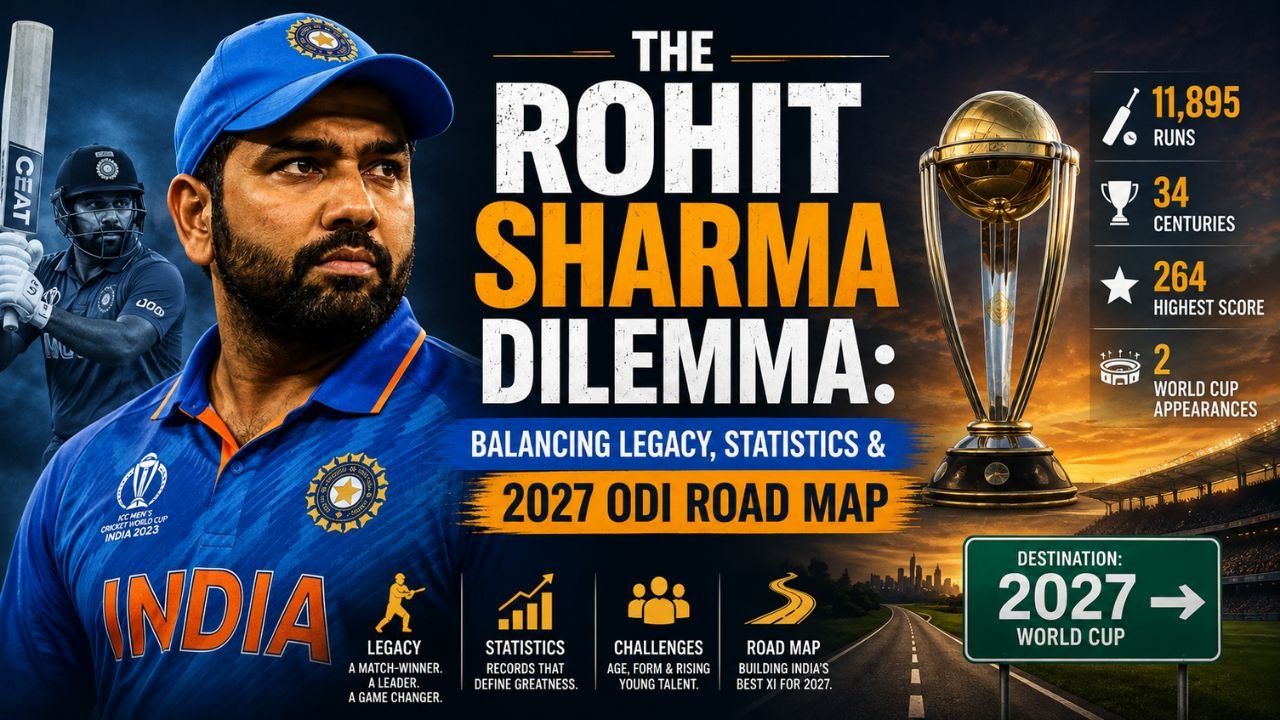
Rohit Sharma’s future in ODI cricket has become one of the biggest talking points in Indian cricket. With the 2027 ODI World Cup – co-hosted by South Africa, Zimbabwe and Namibia – now inside an 18-month planning window, India faces a genuinely difficult question: does it back one of the greatest white-ball batters the game has produced for one final campaign, or does it start a full transition toward the next generation now, while there is still time to build it properly?
What makes this debate so hard to resolve is that Rohit is no longer the automatic pick he once was, yet he is still capable of performances that remind everyone why he was ever considered undroppable in the first place. Recent developments – including a BCCI performance-review meeting in Mumbai and a stunning century at Lord’s – have only sharpened the uncertainty rather than settling it.
Quick Snapshot
| Age | 39 (born 30 April 1987) |
| Format still active in | ODIs only (retired from Tests in May 2025, from T20Is earlier) |
| Career ODI record | ~288 matches, ~11,895 runs, 34 centuries, average ~48–49, highest score 264 |
| 2027 World Cup hosts | South Africa, Zimbabwe, Namibia |
| Current status | BCCI insists he “remains a key player”; selectors reportedly weighing a series-by-series approach |
| Biggest recent statement | 138 off 110 at Lord’s (July 19, 2026), first Indian ODI century at the venue |
| Biggest recent low | Six-innings stretch in Feb 2025 averaging 10.37 vs England |
The Rohit Sharma Dilemma
Rohit is already retired from Test and T20I cricket, which means ODIs are his only remaining international format – and the 2027 World Cup is, realistically, his last shot at a global 50-over title as a player. The question selectors face isn’t whether Rohit has been great. That’s settled. The question is whether his current output and fitness justify a guaranteed seat on the plane more than a year out from the tournament, or whether India needs to start building around younger options immediately.
In mid-2026, speculation intensified that the third ODI of the England series, at Lord’s, could be his last appearance in the format. BCCI secretary Devajit Saikia moved quickly to shut that down, stating plainly that Rohit “remains a key player” and that no such discussion had taken place. Days later, Rohit answered the noise the way he knows best – with a match-defining century. That sequence, in miniature, is the whole dilemma: doubt, followed by a statement innings, followed by more doubt.
Rohit Sharma’s ODI Legacy
Few batters have reshaped ODI opening the way Rohit has. His signature method – build carefully through the first third of an innings, then accelerate into an assault most bowlers can’t legislate for – turned him into the most destructive Indian opener of his generation.
Career-defining numbers and records:
| Record | Detail |
| Highest individual ODI score | 264 vs Sri Lanka (still the all-time record) |
| Most double centuries in ODIs | 3 (unmatched by any other batter) |
| Most sixes in ODI history | Surpassed Shahid Afridi’s long-standing record |
| Most sixes by an opener in ODIs | Surpassed Chris Gayle (Jan 2026) |
| ODI centuries in England | 8 – the most by any batter in a single overseas country |
| First Indian ODI century at Lord’s | July 19, 2026 |
| 2023 World Cup | Led India to the final |
| 2025 Champions Trophy | Captained India to the title, including a decisive 76 in the final |
Beyond the numbers, Rohit’s captaincy legacy matters just as much: he presided over an aggressive, fearless template at the top of the order that reshaped how India approached ODI cricket, and he is only the fourth Indian to reach 20,000 international runs.
Rohit Sharma’s Complete ODI Career Stats
| Metric | Figure |
| Matches | ~288 |
| Innings | ~279 |
| Runs | ~11,895 |
| Batting Average | ~48.5 |
| Strike Rate | ~92.8 |
| Highest Score | 264 vs Sri Lanka (all-time ODI record) |
| Centuries | 34 |
| Half-centuries | 62 |
| Sixes | 355+ (most by any batter in ODI history) |
| Double centuries | 3 (unmatched – the only batter with more than one) |
Rohit Sharma’s World Cup Record
No account of Rohit’s legacy is complete without his World Cup numbers, which is exactly why this decision carries so much weight. He is the only batter in history to score 500-plus runs in three consecutive World Cup editions, and only Sachin Tendulkar has scored more World Cup centuries for India.
| World Cup | Matches | Runs | Average | Strike Rate | Centuries | India’s Finish |
| 2015 (Australia/NZ) | 8 | 330 | 55.00 | ~93 | 1 (137 vs Bangladesh) | Semi-final |
| 2019 (England) | 9 | 648 | ~81.0 | ~96.2 | 5 (record for a single edition) | Semi-final |
| 2023 (India) | 11 | 597 | 54.27 | 125.94 | 1 (131 vs Afghanistan) | Runner-up |
Standout World Cup records:
| Record | Detail |
| Most centuries in World Cup history | 7 (passed Tendulkar’s 6, in Oct 2023) |
| Most centuries in a single World Cup edition | 5 (2019 – still unmatched) |
| Fastest World Cup century by an Indian | 100 off 63 balls vs Afghanistan (2023) |
| Most runs by a captain in a single World Cup edition | 597 (2023) |
| Most sixes by a captain in a single World Cup edition | Surpassed Eoin Morgan’s 22 (2019 record) |
| India’s 2023 campaign under his captaincy | Won all 10 group and knockout games before losing the final – one of the most dominant runner-up campaigns in the tournament’s history |
Current Form: A Genuine Rollercoaster
This is where the “dilemma” earns its name – Rohit’s 2025–26 form has swung between two extremes, sometimes within the same series.
The lows:
- February 2025: failed to reach double figures in six consecutive ODI innings during a lean patch against England, averaging just 10.37 across that stretch.
- July 2026 vs England: scored 26 and 11 in the first two ODIs of the series, fuelling retirement speculation ahead of the Lord’s decider.
The highs:
- October 2025: an unbeaten century in Sydney sealed a series win over Australia and made Rohit the world’s No. 1 ranked ODI batter for the first time in his career.
- November–December 2025: a rapid 57 off 51 balls and a match-winning 75 in a successful chase against South Africa in Visakhapatnam, plus surpassing Afridi’s all-time ODI sixes record.
- January 2026 vs New Zealand: broke Chris Gayle’s record for most sixes by an ODI opener and passed 650 sixes in international cricket, becoming the first player to do so.
- July 19, 2026 (Lord’s): 138 off 110 balls (17 fours, five sixes) – his 34th ODI century, first Indian ODI ton at Lord’s, and the highest score by an Indian against England on English soil, surpassing his own 137 not out at Trent Bridge in 2018.
The pattern is unmistakable: Rohit is either among the best ODI batters alive, or he is struggling to time the ball at all – with very little middle ground. That volatility, more than his age on paper, is what genuinely worries selectors.
Why the BCCI Meeting Matters
India’s ODI future – and Rohit’s place in it – was the central item when BCCI secretary Devajit Saikia, president Mithun Manhas, head coach Gautam Gambhir, chief selector Ajit Agarkar and Centre of Excellence chief VVS Laxman met in Mumbai for a wide-ranging performance review, with captain Shubman Gill and T20I captain Shreyas Iyer also expected to attend.
Officially on the agenda:
- Recent ODI series losses in Ireland and England
- Series wins over Zimbabwe and Sri Lanka
- Persistent injury concerns, particularly around Hardik Pandya
- Building a clear roadmap through the New Zealand tour and the Border-Gavaskar Trophy to the 2027 World Cup
Unofficially, but undeniably, the headline issue: whether Rohit Sharma is formally part of that roadmap.
The Gill Factor
This drags in a second, less-discussed cost: the impact on captain Shubman Gill. A BCCI source has noted that the lack of clear direction makes life difficult for a young captain trying to build a settled dressing room while simultaneously managing senior players with far greater experience and standing than his own. An unresolved Rohit question doesn’t just affect one batting slot – it affects how much authority and continuity Gill can establish as India’s long-term ODI leader.
Not Just Rohit: The Wider Veteran Question
It’s worth remembering that Rohit isn’t the only senior figure whose 2027 place is under scrutiny. Virat Kohli and Ravindra Jadeja – both part of the core that reached the 2023 World Cup final – are in a similar position, chasing what would likely be a final global tournament of their careers. Kohli has firmly ruled out any return to Tests or T20Is but has continued playing ODIs, including a match-winning century against South Africa in late November 2025. This makes the Rohit decision less an isolated call and more the first domino in a broader generational transition that India’s selectors will have to manage across at least two, possibly three, senior positions over the same 18-month window.
Road to 2027: India’s Remaining ODI Calendar
Rohit’s case will effectively be judged across a packed white-ball season between now and the World Cup. The key ODI assignments on India’s Future Tours Programme include:
| Series | Approximate Window | Format Mix |
| West Indies (home) | Late Sept–Oct 2026 | 3 ODIs, 5 T20Is |
| New Zealand (away) | Oct 2026 | 5 ODIs, 3 T20Is, 2 Tests |
| Sri Lanka (home) | Dec 2026 | 3 ODIs, 3 T20Is |
| Zimbabwe (home) | Jan 2027 | 3 ODIs |
| Border-Gavaskar Trophy vs Australia (home, Tests) | 21 Jan–3 Mar 2027 | 5 Tests |
Every one of these ODI series between now and the tournament effectively functions as an audition – both for Rohit to make his case with the bat, and for selectors to test alternatives at the top of the order without the pressure of a live World Cup squad announcement.
Who Could Replace Him? A Closer Look at the Succession Options
The most frequently mentioned long-term successor is Yashasvi Jaiswal, and the case for him is more than just potential. In the same Visakhapatnam ODI in which Rohit made his fighting 75, Jaiswal struck an unbeaten 116, building a 155-run opening stand with Rohit himself – effectively auditioning as his eventual replacement while batting alongside him. Jaiswal has also established himself as a first-choice Test opener with a double century and multiple hundreds against England and Australia, showing he already has the technique and temperament for the highest level; the remaining question is simply translating that into sustained 50-over consistency at the top of an ODI order.
What Former Players Are Saying
The debate isn’t confined to BCCI boardrooms – India’s cricketing greats have weighed in publicly, often with visible affection for Rohit even while acknowledging the selection dilemma:
- Sourav Ganguly has cautioned that staying fit and holding down a place through to 2027 won’t be straightforward for either Rohit or Kohli, given their age profile.
- Kapil Dev, responding to the Lord’s retirement speculation, praised Rohit’s contribution to Indian cricket and said he would wish him well whenever he does decide to step away – while stopping short of calling for an immediate exit.
- BCCI secretary Devajit Saikia has been the most consequential voice of all, repeatedly and publicly insisting Rohit “remains a key player” for India, even as team-internal discussions about a series-by-series approach continue.
Experience vs Youth: Weighing the Road Map
| Factor | Case for keeping Rohit | Case for transitioning away |
| Current ranking/form peak | Was the ICC’s No. 1 ranked ODI batter as recently as October 2025 | Form has been extremely inconsistent across the same 18-month window |
| Big-match temperament | Lord’s century came under direct retirement pressure; multiple match-winning knocks in crunch chases | Six-innings failure streak came in a home series against England, not a weak attack |
| Fitness/age | Still scoring at a strike rate near 93 in ODIs; no fitness red flags reported | Will be approaching 40 by the 2027 tournament; workload management is already a live issue across the squad |
| Squad depth | No opener has definitively outperformed him over a sustained run yet | Younger options such as Yashasvi Jaiswal need consistent exposure well before a World Cup, not a late audition |
| Leadership/dressing room | Enormous experience of ICC knockouts and finals | Uncertainty around his role is reportedly complicating Gill’s captaincy |
| BCCI’s own public position | Officially “remains a key player” (Saikia, July 2026) | Selectors reportedly still weighing a series-by-series rather than cycle-long commitment |
There is no low-risk option here. Commit to Rohit through 2027, and India risks tying a key batting slot to a player whose form has been genuinely volatile, at the cost of not giving a younger opener the two years of exposure a World Cup slot really requires. Move him out now, and India risks discarding a batter who was – by the ICC’s own rankings – the best ODI batter in the world barely a year ago, while also unsettling a leadership core that has delivered a World Cup final and a Champions Trophy title in the last three years.
What Rohit Needs to Show Between Now and 2027
- Consistency, not just brilliance – isolated masterclasses like Lord’s are valuable, but selectors will be looking for a sustained run of scores, not peaks separated by long troughs.
- Fitness through a full bilateral calendar – staying available and effective across back-to-back series, not just marquee fixtures.
- Continued value at the top of the order – his strike rate and six-hitting remain elite; maintaining that impact is central to his case.
- A settled role alongside Gill and Kohli – clarity here would help the team as much as it helps Rohit’s own case.
Should Rohit Play the 2027 World Cup?
It’s too early to call Rohit’s place in India’s 2027 World Cup squad either guaranteed or ruled out. His record gives him a compelling case; his age and the need for a smooth generational transition give selectors legitimate reasons for caution.
The fairest resolution is the simplest one: let performance decide. If Rohit continues to produce match-winning innings, stays fit, and remains a genuine upgrade at the top of the order, there is a strong case for taking him to South Africa, Zimbabwe and Namibia. If his form dips for a sustained period and a younger opener clearly establishes himself, India will need to make the harder call.
For now, the 2027 dream is alive – and Rohit, as he showed at Lord’s, still knows exactly how to keep it that way. And whatever India decides about its most famous opener will inevitably shape how it handles Kohli, Jadeja, and the rest of its ageing core – making this less a single selection call and more the opening chapter of Indian cricket’s next generational shift.
Read Also: Pakistan Women’s Cricket Team 2026: Captain, Squad & Rankings
Frequently Asked Questions
No official retirement has been announced. BCCI secretary Devajit Saikia has publicly dismissed retirement speculation, saying Rohit “remains a key player.”
Rohit had scored just 26 and 11 in the first two ODIs vs England. He answered with 138 off 110, becoming the first Indian to score an ODI century at Lord’s.
It’s undecided. Rohit reportedly wants to play, but selectors are said to be considering a series-by-series evaluation rather than a full-cycle guarantee.
It will be jointly hosted by South Africa, Zimbabwe and Namibia, meaning India will face varied conditions across three countries.
Yashasvi Jaiswal is the name most consistently linked with a long-term opening slot as part of India’s 2027 planning.
Yes. He has already stepped away from Test cricket (May 2025) and T20I cricket, leaving ODIs as his only remaining format.
He led India to the 2023 World Cup final and captained the side to the 2025 Champions Trophy title, scoring a decisive 76 in that final.
Selectors would reassess his place after each series based on current form and fitness, rather than committing him to the full World Cup cycle.
Source: The Times of India