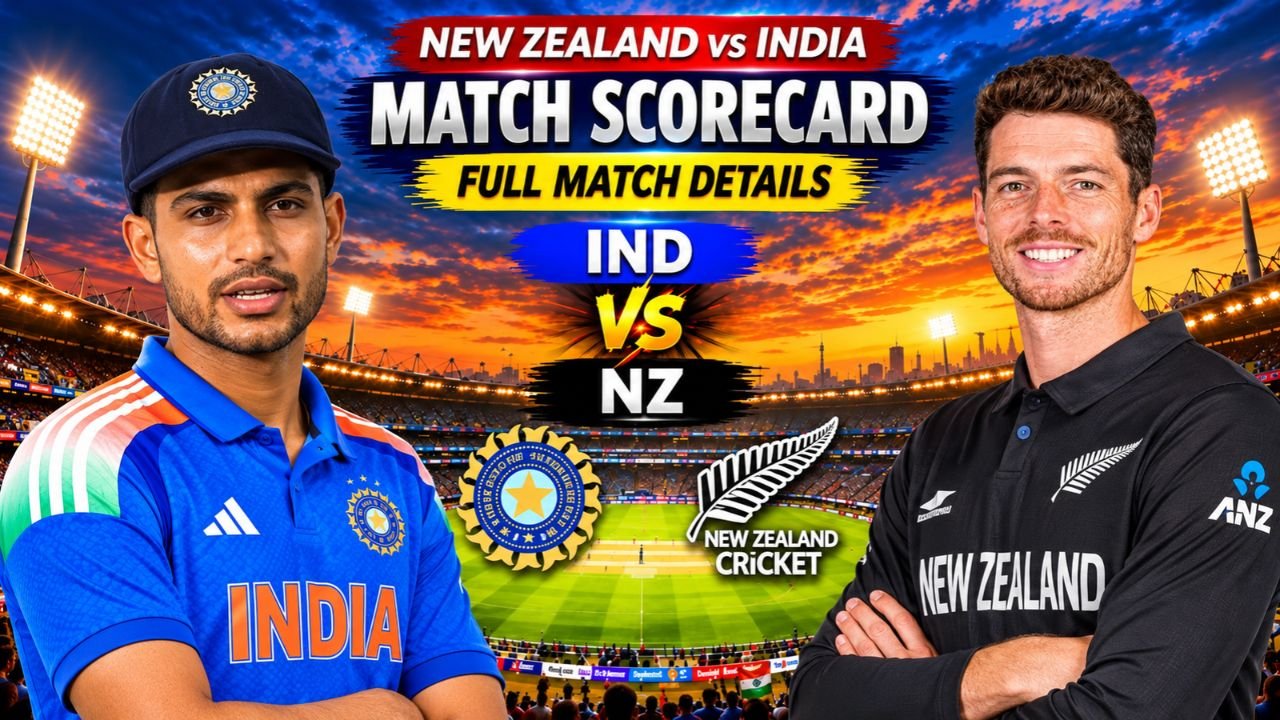
The New Zealand national cricket team vs India national cricket team match was the first ODI of India’s 2026 tour of New Zealand. The match took place on Wednesday, November 4, 2026, at Eden Park in Auckland. India won the toss and elected to bowl first. New Zealand were bowled out for 185 runs in 40.2 overs. India’s bowlers delivered an impressive performance, with Arshdeep Singh taking four wickets, Gurnoor Brar claiming three wickets and Anshul Kamboj picking up two wickets. India successfully chased the revised target of 143 runs in 22.4 overs, finishing at 143/5. Virat Kohli played a match-winning innings of 74 runs from 51 balls. India won the rain-affected match by five wickets under the Duckworth-Lewis-Stern (DLS) method.
New Zealand vs India Match Summary
| Match Information | Details |
|---|---|
| Match | New Zealand vs India |
| Series | India Tour of New Zealand 2026 |
| Match Number | 1st ODI |
| Date | 4 November 2026 |
| Venue | Eden Park, Auckland |
| Toss | India won and elected to bowl |
| New Zealand Score | 185 all out (40.2 overs) |
| India Score | 143/5 (22.4 overs) |
| Revised Target | 143 runs |
| Result | India won by 5 wickets (DLS) |
| Player of the Match | Anshul Kamboj |
New Zealand National Cricket Team vs India National Cricket Team Scorecard
Batting Scorecard New Zealand
| Batter | Runs | Balls | 4s | 6s | Strike Rate |
|---|---|---|---|---|---|
| Will Young | 9 | 11 | 2 | 0 | 81.82 |
| Tim Seifert | 38 | 43 | 3 | 2 | 88.37 |
| Henry Nicholls | 9 | 11 | 2 | 0 | 81.82 |
| Daryl Mitchell | 28 | 41 | 3 | 1 | 68.29 |
| Tom Latham | 3 | 11 | 0 | 0 | 27.27 |
| Glenn Phillips | 30 | 51 | 2 | 1 | 58.82 |
| Mitchell Santner | 4 | 16 | 0 | 0 | 25.00 |
| Nathan Smith | 1 | 9 | 0 | 0 | 11.11 |
| Kyle Jamieson | 1 | 6 | 0 | 0 | 16.67 |
| Jacob Duffy | 15* | 21 | 3 | 0 | 71.43 |
| Blair Tickner | 34 | 23 | 1 | 4 | 147.83 |
| Extras | 13 | ||||
| Total | 185 all out | 40.2 overs |
Top scorer: Tim Seifert (38 runs).
India Bowling Scorecard
| Bowler | Overs | Maidens | Runs | Wickets | Economy |
|---|---|---|---|---|---|
| Arshdeep Singh | 10 | 0 | 70 | 4 | 7.00 |
| Auqib Nabi | 6 | 0 | 33 | 0 | 5.50 |
| Anshul Kamboj | 10 | 2 | 22 | 2 | 2.20 |
| Gurnoor Brar | 9.2 | 0 | 44 | 3 | 4.71 |
| Axar Patel | 5 | 0 | 12 | 0 | 2.40 |
Arshdeep Singh was India’s leading wicket-taker with four wickets, while Anshul Kamboj delivered an economical spell of 2/22 in 10 overs.
India Batting Scorecard
India successfully reached the revised DLS target of 143 runs in 22.4 overs, losing five wickets. Virat Kohli led the chase with an important 74-run innings.
| Batter | Runs | Balls | 4s | 6s |
|---|---|---|---|---|
| Rohit Sharma | 0 | 6 | 0 | 0 |
| Shubman Gill | — | — | — | — |
| Virat Kohli | 74 | 51 | — | — |
| Other Indian batters | — | — | — | — |
| Total | 143/5 | 22.4 overs |
Note: Individual batting figures other than Virat Kohli’s score have not been fully verified in the available final scorecard sources.
India Bowling Performance: Key Highlights
India’s bowling attack played a major role in restricting New Zealand to 185 runs.
- Arshdeep Singh picked up four wickets for 70 runs.
- Gurnoor Brar took three wickets for 44 runs.
- Anshul Kamboj claimed two wickets for just 22 runs.
- Axar Patel conceded only 12 runs in five overs.
- New Zealand lost all 10 wickets in 40.2 overs.
Anshul Kamboj’s economical bowling performance was particularly important in restricting New Zealand’s scoring opportunities.
Virat Kohli’s Match-Winning Performance
Virat Kohli was one of the biggest highlights of the first ODI. He scored 74 runs from 51 deliveries, helping India maintain control of the revised run chase.
His innings included aggressive stroke play and an important contribution towards India’s successful chase. He also took a spectacular diving catch during New Zealand’s innings.
Player of the Match
Anshul Kamboj was named Player of the Match for his impressive bowling performance. His figures of 2 wickets for 22 runs in 10 overs helped India restrict New Zealand to a manageable total.
New Zealand vs India: Fall of Wickets
| Score | Wicket |
|---|---|
| 22/1 | Will Young |
| 40/2 | Henry Nicholls |
| 73/3 | Tim Seifert |
| 84/4 | Tom Latham |
| 97/5 | Daryl Mitchell |
| 113/6 | Mitchell Santner |
| 115/7 | Nathan Smith |
| 131/8 | Kyle Jamieson |
| 146/9 | Glenn Phillips |
| 185/10 | Blair Tickner |
What Happened in the Match?
New Zealand started their innings after India elected to bowl first. Tim Seifert provided some stability with 38 runs, while Daryl Mitchell and Glenn Phillips contributed 28 and 30 runs respectively. Blair Tickner added a quick 34 runs towards the end of the innings.
However, India’s bowling attack kept taking wickets at regular intervals. Arshdeep Singh and Gurnoor Brar made important breakthroughs, while Anshul Kamboj controlled the scoring with his disciplined bowling.
New Zealand were eventually dismissed for 185 runs in 40.2 overs.
India began their chase but lost Rohit Sharma early. Rain interrupted the match, resulting in a revised DLS target of 143 runs. Virat Kohli then played a crucial innings of 74 from 51 balls, guiding India towards victory.
India reached 143/5 in 22.4 overs and secured a five-wicket win.
New Zealand vs India ODI Series 2026
The first ODI victory gave India a 1-0 lead in the five-match series. The teams are scheduled to continue their ODI series with the second match in Wellington on November 7, 2026.
The remaining matches are scheduled for November 10, 13 and 15.
Frequently Asked Questions (FAQs)
India won the first ODI against New Zealand by five wickets using the DLS method.
New Zealand scored 185 runs before being bowled out in 40.2 overs.
India scored 143/5 in 22.4 overs while chasing the revised target of 143 runs.
Anshul Kamboj received the Player of the Match award for taking two wickets for 22 runs in 10 overs.
Virat Kohli scored 74 runs from 51 balls.
Arshdeep Singh took four wickets for 70 runs in 10 overs.
The match was played at Eden Park in Auckland, New Zealand.
India took a 1-0 lead in the five-match ODI series after winning the opening match by five wickets under the DLS method.